
Imperial Diet: Difference between revisions
No edit summary |
No edit summary |
||
| (One intermediate revision by the same user not shown) | |||
| Line 116: | Line 116: | ||
Anhalt 1260.svg|38. [[Principality of Anhalt|Prince of Anhalt]] | Anhalt 1260.svg|38. [[Principality of Anhalt|Prince of Anhalt]] | ||
Henneberg.svg|39. [[County of Henneberg|Princely Count of Henneberg]] | Henneberg.svg|39. [[County of Henneberg|Princely Count of Henneberg]] | ||
Schwerin Principality.svg|40. [[ | Schwerin Principality.svg|40. [[Prince-Bishopric of Schwerin|Prince of Schwerin]] | ||
Kammin.svg|41. [[ Prince-Bishopric of Cammin |Prince of Kammin]] | Kammin.svg|41. [[ Prince-Bishopric of Cammin |Prince of Kammin]] | ||
Ratzeburg Principality.svg|42. [[Prince-Bishopric of Ratzeburg|Prince of Ratzeburg]] | Ratzeburg Principality.svg|42. [[Prince-Bishopric of Ratzeburg|Prince of Ratzeburg]] | ||
| Line 166: | Line 166: | ||
Nuremberg.svg|[[ Imperial Free City of Nuremberg| Free and Imperial City of Nuremberg]] | Nuremberg.svg|[[ Imperial Free City of Nuremberg| Free and Imperial City of Nuremberg]] | ||
Ulm.svg|Free and Imperial City of Ulm | Ulm.svg|Free and Imperial City of Ulm | ||
Schwäbisch Hall.svg|[[ Imperial Free City of Schwäbisch Hall|Free and Imperial City of Schwäbisch Hall]] | |||
Überlingen.svg|Free and Imperial City of Überlingen | Überlingen.svg|Free and Imperial City of Überlingen | ||
Schwäbisch_Gmünd.svg|Free and Imperial City of Schwäbisch Gmünd | Schwäbisch_Gmünd.svg|Free and Imperial City of Schwäbisch Gmünd | ||
Latest revision as of 09:35, 30 March 2026
Imperial Diet of the Holy Roman Empire
The Imperial Diet (Reichstag) was the forum where the Imperial Estates and the Emperor could discuss and negotiate issues from the early modern period of the Empire onwards ; what it enacted was Imperial Law.
The Imperial Estates (Reichsstände) were the territories that enjoyed imperial immediacy (Reichsunmittelbarkeit), that is the Emperor was their immediate and direct feudal lord, since the territories they held were formally feudal fiefs. Alongside this immediacy, the Imperial Estates had to share the burden of the Empire and were to pay taxes to fund the various bodies whose responsability was to maintain the common legal framework that characterised the social and political order of the Empire ; these two criteria thus determined whether or not a territory formally attached to the Empire could enjoy the right to participate and vote in the Diet.
College of Electors | College of Princes | Ecclesiastical Bench | Secular Bench | College of Imperial Cities | Rhenish Bench | Swabian Bench
- College of Electors
-

1. Archbishop of Mainz
Arch-Chancellor of Germany
Head of Corpus Catholicorum -

2. Archbishop of Trier
Arch-Chancellor of Gaul -

3. Archbishop of Cologne
Arch-Chancellor of Italy


-

4. King of Bohemia
Arch-Butler of the Empire -

5. Count Palatine of the Rhine
Arch-Steward of the Empire
Imperial Vicar for Frankish territories -

6. Duke of Saxony
Arch-Marshal of the Empire
Imperial Vicar for Saxon territories
Head of Corpus Evangelicorum -

7. Margrave of Brandenburg
Arch-Chamberlain of the Empire -

8. Duke of Brunswick-Lüneburg
Arch-Treasurer of the Empire


College of Electors | College of Princes | Ecclesiastical Bench | Secular Bench | College of Imperial Cities | Rhenish Bench | Swabian Bench
- College of Princes
-

-


College of Electors | College of Princes | Ecclesiastical Bench | Secular Bench | College of Imperial Cities | Rhenish Bench | Swabian Bench
- Ecclesiastical Bench
-

-

-

-

-

-

-

-

10. Bishop of Speyer
-

-

-

-

-

-

-

-

18. Bishop of Passau
-

19. Bishop of Trent
-

20. Bishop of Brixen
-

21. Bishop of Basel
-

-

-

24. Bishop of Liège
-

25. Bishop of Lübeck
-

26. Bishop of Chur
-

27. Bishop of Fulda
-

28. Abbot of Kempten
-

-

-

31. Prior of Berchtesgaden
-

32. Provost of Weissenburg
-

33. Abbot of Prüm
-

34. Abbot of Stablo
-

35. Abbot of Corvey


College of Electors | College of Princes | Ecclesiastical Bench | Secular Bench | College of Imperial Cities | Rhenish Bench | Swabian Bench
- Secular Bench
-

-

-

-

-

-

-

-

-

-

-

-

-

-

-

-

-

-
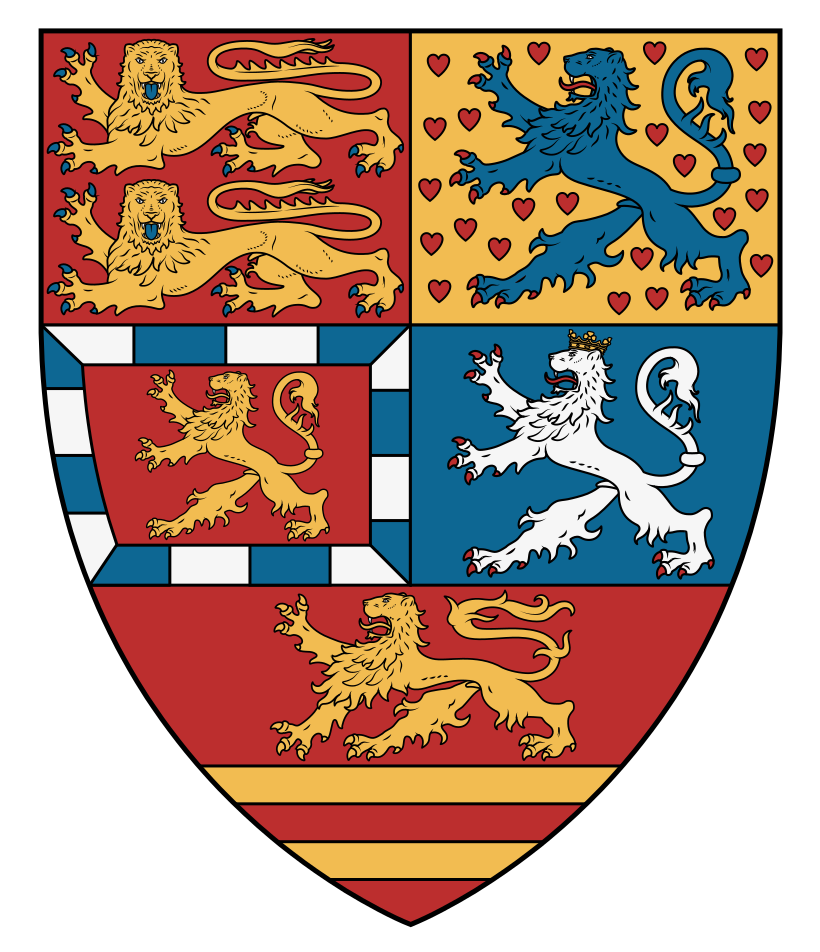
-

-

-

-
-

-

-

-

-

-

-

-

30. Prince of Verden
-

-

32. Duke of Holstein
-

-

34. Prince of Minden
-

-

36. Duke of Savoy
-

-

38. Prince of Anhalt
-

-

-

41. Prince of Kammin
-

-

-

44. Prince of Nomény
-

-

46. Duke of Arenberg
-

-

48. Prince of Lobkowitz
-

49. Prince of Salm
-

-

-

-

53. Prince of Auersperg
-

-

-

56. Prince of Schwarzenberg
-

57. Prince of Liechtenstein
-

58. Prince of Thurn und Taxis
-


College of Electors | College of Princes | Ecclesiastical Bench | Secular Bench | College of Imperial Cities | Rhenish Bench | Swabian Bench
- College of Imperial Cities
- Rhenish Bench
-

-

-

-

-

Free and Imperial City of Frankfurt
-

Free and Imperial City of Goslar
-

Free and Imperial City of Bremen
-

-

-

Free and Imperial City of Nordhausen
-

Free and Imperial City of Dortmund


College of Electors | College of Princes | Ecclesiastical Bench | Secular Bench | College of Imperial Cities | Rhenish Bench | Swabian Bench
- Swabian Bench
-

Free and Imperial City of Regensburg
-

-

-

Free and Imperial City of Ulm
-

-

Free and Imperial City of Überlingen
-

Free and Imperial City of Schwäbisch Gmünd
-

Free and Imperial City of Lindau
-

Free and Imperial City of Dinkelsbühl
-

-

-

-

-

-

-

Free and Imperial City of Offenburg
-

-

Free and Imperial City of Wimpfen
-

-

Free and Imperial City of Giengen
-
Free and Imperial City of Zell am Harmersbach
-
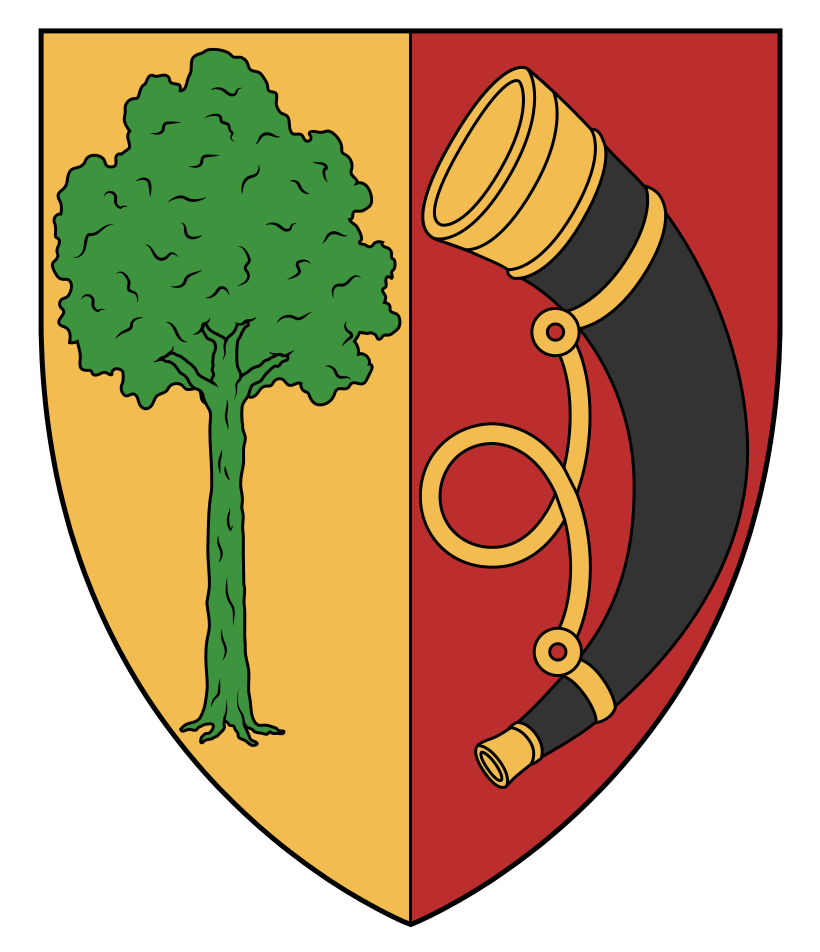
Free and Imperial City of Buchhorn
-

Free and Imperial City of Buchau


College of Electors | College of Princes | Ecclesiastical Bench | Secular Bench | College of Imperial Cities | Rhenish Bench | Swabian Bench | College of Imperial Cities | Rhenish Bench | Swabian Bench

